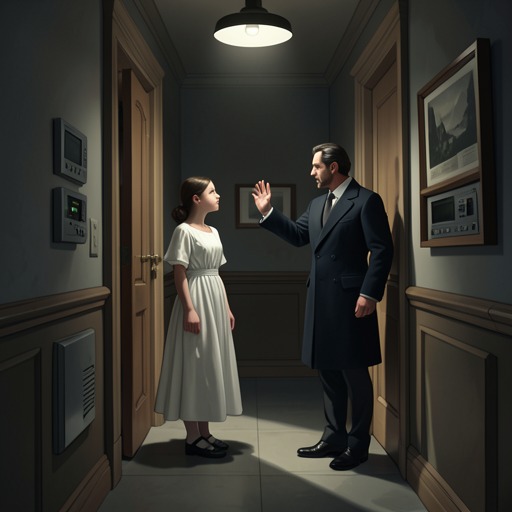
Rhoda burns Leroy alive
The Bad SeedRhoda burns Leroy alive after he discovers the shoes she had hidden and becomes a threat to her. She sets fire to his makeshift bed in the basement, then leaves him trapped behind a bolted door while she eats an ice-cream stick nearby. Leroy’s death turns Rhoda’s composed innocence into a chilling performance of indifference, while Christine watches the killing unfold and is left physically overcome by what she has seen.
Causes and Background
The killing follows a change in Leroy’s understanding of Rhoda. After discovering the retrieved shoes, he had first imagined telling Thelma Jessup about them; then, convinced that Rhoda had killed a boy, he resolved to tell no one and avoid her. The next morning he came to work determined to keep away. Rhoda did not come into the park, but watched him from her window, following his movements with her eyes. When their glances met, Leroy saw what he understood as fury and cold, calculating anger in her face. His fear and decision to stay silent did not remove the danger he posed: Rhoda knew he had found the shoes, and she acted to prevent the discovery from reaching anyone else.
On the day of the fire, an ice-cream seller drew the neighborhood children out of the park and courtyard, leaving the area temporarily deserted. Rhoda asked Christine for money to buy an ice-cream stick. Before going downstairs, she entered the kitchen and took three large matches from the box above the stove. She considered them briefly, returned one, and kept two. Christine watched this preparation from the kitchen window, wondering what Rhoda intended to do with the matches. The ordinary errand and small treat provided cover for a deliberate act.
The Fire and Leroy’s Death
After buying her ice cream, Rhoda sat on the steps near the basement and ate with small, measured bites, listening to Leroy snore in the room beyond. She then went cautiously to the basement door, checked whether anyone was watching, struck a match against the cement wall, and shielded its flame with her palm. On tiptoe, she entered the room and touched the match to the excelsior and piled papers that formed Leroy’s makeshift bed. She quietly came back out, closed the door, and slipped the flimsy bolt into place. She rattled it about before returning to her seat with the burned match still in her hand.
The fire begins with a contrast between Rhoda’s casual movements and the danger inside the locked room. Christine stands paralyzed beside the curtain; when she finally screams, Leroy’s cries answer from the other side of the door. Smoke rolls from the barred windows. Leroy throws himself against the door, then appears at a window and sees Rhoda still eating her ice cream. He calls, “Unlock the door, Rhoda! I’m not mad at you!” Rhoda laughs and shakes her head. In the scene’s starkest reversal, the child at ease outside the basement has control over the trapped adult, who can only plead with her.
As the fire continues, Leroy recognizes what has happened. He cries, “I haven’t got them shoes! I was only teasing you a little! I don’t know nothing about them shoes!” Rhoda answers gently, “You know,” and then, “You know where they are.” His denial and appeal come too late: her response makes clear that the shoes, not any immediate attack on her, are the focus of the confrontation. She keeps eating while he throws his weight against the door repeatedly. When the bolt finally gives way, Leroy runs into the courtyard with his clothing burned away and clinging to his blackened body in fiery rags. His shoestrings and hair are also ablaze. He protests, “I wasn’t going to tell on you! I don’t know nothing about nothing you done!” Rhoda touches her tongue to the last of her treat, presses her palms together, and laughs her tinkling childhood laugh. Her reply is, “You’re silly.”
Leroy runs toward the lily pond, but reaches the gate instead. Still clutching it, he shudders, sways backward, and sags to the cement. He releases his grip and dies there. The sequence makes the failed escape part of the horror: even after breaking through the basement door, he cannot get away from the fire Rhoda has set.
Christine’s Witness and the Aftermath
Christine sees Rhoda take the matches, approach the basement, light the bed, and leave Leroy behind the bolted door. Yet the act unfolds with such casual efficiency that Christine cannot at first accept what she has watched. Her inability to respond in time gives way to a scream as Leroy’s answering cries make the danger undeniable. Rhoda’s face and behavior offer no visible sign of alarm or remorse; Christine, by contrast, tries to hold herself together after Leroy dies. She tells herself, “I’m not going to faint. This is an emergency. It’s necessary for me to keep calm.”
Her effort fails. Christine heads toward her bedroom intending to lie down, but her knees buckle before she reaches the bed. She loses consciousness, then comes to herself going down the back stairs, holding the railing and calling Rhoda’s name in a frantic voice. The event thus leaves her not merely as a witness to a death but as a mother confronting, at close range, the violence her daughter has chosen. The ordinary details surrounding the killing—the ice-cream seller, the kitchen matches, the basement door, and the garbage can beneath the stairs where Rhoda discards her stick and its waxed paper—make the scene’s moral contrast sharper: Rhoda treats the killing as a task completed amid an unremarkable afternoon, while Christine’s body registers the catastrophe she cannot yet master.
Significance
The killing turns the hidden shoes into the immediate stake in an already unequal contest. Leroy has discovered them and can expose Rhoda, but his fear has made him hesitate; even as he burns, he insists he was not going to tell. Rhoda nevertheless acts as though his knowledge is intolerable. Her choice to ignite the bed, secure the door, and remain nearby converts concealment into murder.
The scene also makes innocence a visible performance. Rhoda eats delicately, disposes of the remains of her treat, and smiles as Leroy runs in flames; those childlike gestures do not soften the violence but heighten its contrast. Her calm presence beside the basement door is set against Leroy’s increasingly desperate pleas and Christine’s paralysis and collapse. By making Christine witness the whole sequence, the episode establishes the cost of Rhoda’s act within the family as well as for its victim: the mother’s knowledge is no longer suspicion alone, but an experience she has seen and cannot keep at a distance.